
Maywood Collections Coverage
The strongest Maywood city directory search starts by naming the collection, years, place, and access mode. LAPL's digitized selection covers Los Angeles-area city and street directories from 1875-1987, but a Maywood hit must be checked in each volume. LAPL Central Library holds Los Angeles directories from 1873-1942, more than 5,000 directory microfilm rolls for U.S. cities from 1861-1960, roughly 1,000 hard-copy directories, phone books, maps, newspapers, and genealogy resources. The table keeps those broad holdings distinct from a verified Maywood-only run.
| Collection | Years | Where held | Access |
|---|---|---|---|
| LA-area city and street directories | 1875-1987 digitized selection | LAPL ResCarta | Free online; verify Maywood |
| Los Angeles city directories | 1873-1942 | LAPL paper and microfilm | Central Library reference use |
| Reverse or street directories | 1906, 1927, 1956-1987 | ResCarta and Central Library | Volume and city coverage varies |
| Los Angeles telephone books | From 1914 | LAPL reference | In person; not a complete resident roll |
| California voter registrations | 1900-1968 | Ancestry Library Edition | Library database rules apply |
| Federal census schedules | Through 1950 | NARA, FamilySearch, libraries | Public under the 72-year rule |
| Sanborn California maps | 1888-1950 microfilm | LAPL and map resources | Verify Maywood sheets |
| LA naturalization series | 1852-2000, series dependent | NARA Riverside/Perris | Index and file access vary |
The LAPL collection browser shows the reverse and city-directory shelves that form the historical Maywood residents trail.
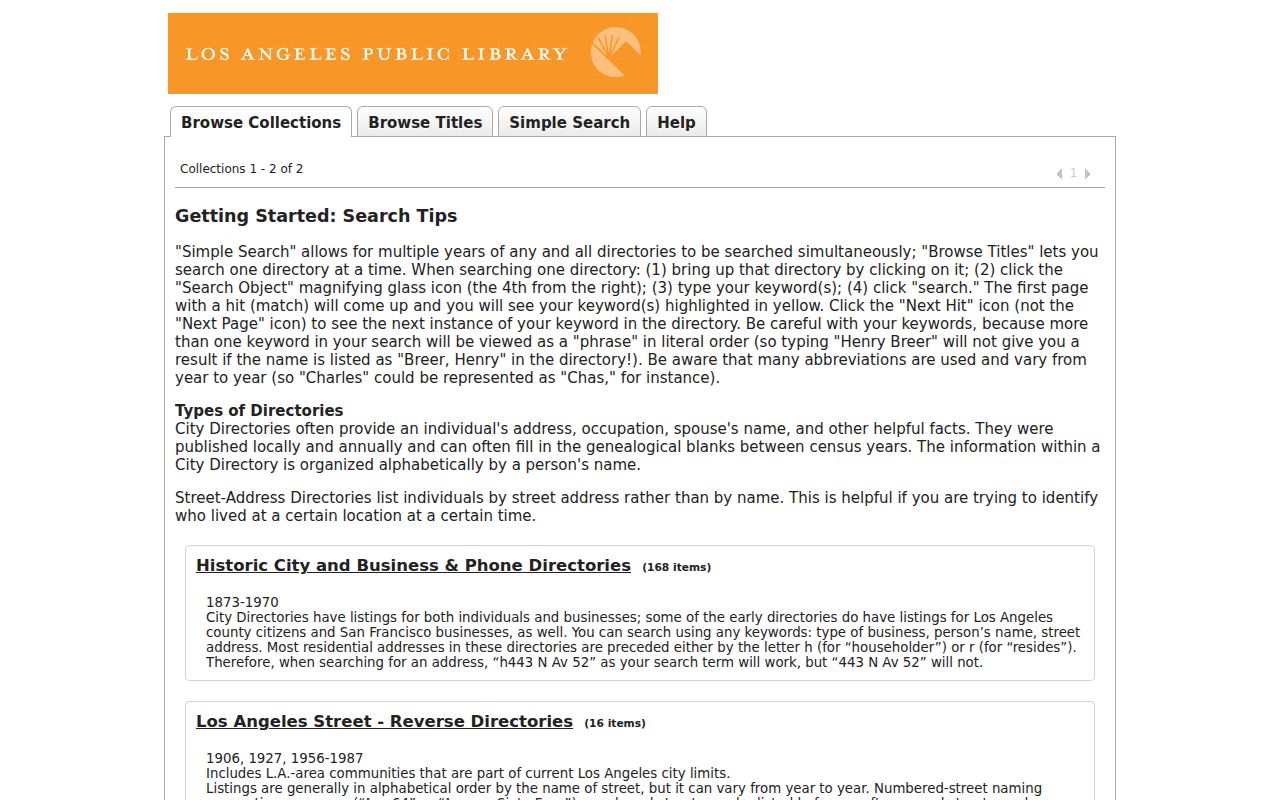
Collection labels matter because a broad Los Angeles run may include Maywood in one year and omit it in another.
Search Maywood Directory Pages
LAPL's City Directories Index provides the cleanest digital starting point. Its fields are Keyword, City or Community, County, State, and Region. Boolean controls allow an all-words search with &, either-word search with /, and truncation with *. Try Maywood in the community field, Los Angeles in the county field, and CA in the state field. Then inspect the actual page image and the volume's coverage notes.
Address searches can work inside digitized books, but OCR may miss a hyphen, accent, abbreviation, or faint street number. Search a surname, a street number, and a quoted address variant. Try “Ave 64” and a spelled-out number when the older directory uses a different convention. Save the page number, volume year, publisher line, and exact spelling before comparing another year.
The LAPL digitized city and street directory landing page identifies the free image collection.
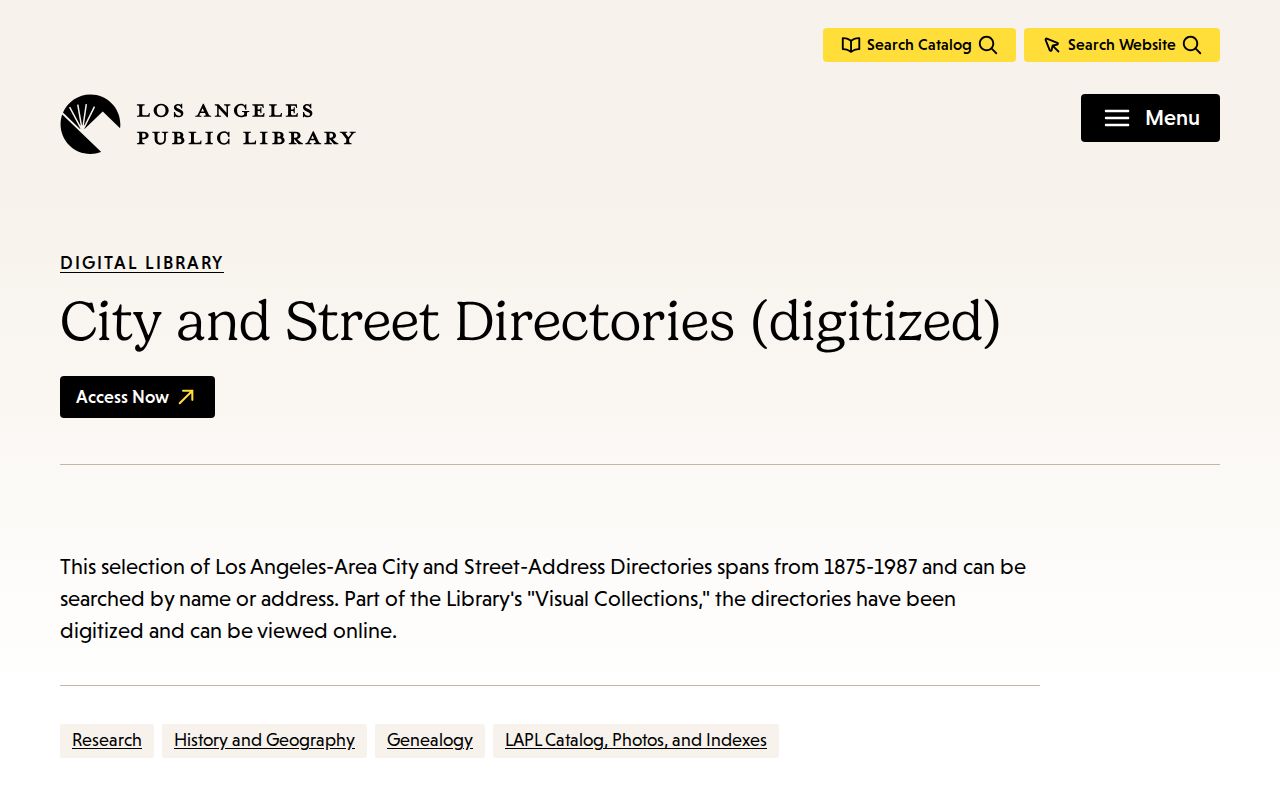
A scanned page is useful evidence only after the city or community label and year are recorded.
| Search choice | Maywood use |
|---|---|
| Keyword | Try surname, street, business, or institution terms. |
| City or Community | Enter Maywood, then test the broader Los Angeles label if needed. |
| County | Use Los Angeles to narrow regional hits. |
| State | Use CA as the two-letter state filter. |
| Boolean operators | & for all words, / for either, * for truncation. |
Maywood City and Reverse Directories
A traditional city directory is name-led. An entry may give a person's name, occupation, institution, residence, spouse notation, and an abbreviation such as “r” for residence or “b” for boarding. A reverse or criss-cross directory is address-led. It may name the listed householder or business beside a street number. The two formats answer different questions and should not be blended into one current residents directory.
LAPL's reverse collection identifies 1906, 1927, and 1956-1987 runs, with some Los Angeles County cities covered only in certain volumes. A Maywood address may therefore appear in one run but not the next. Printed books can also use a postal or community label that differs from modern city limits. Search the street guide and the city index before treating a missing entry as a move.
- Criss-cross directory
- A street-order section that turns a covered address into a listed name or business.
- Householder index
- A name or address aid that points to the person a publisher chose to list, not every household member.
- Abbreviation key
- The volume's legend for residence, boarding, occupation, spouse, or business marks.
- OCR variant
- A scan-reading error or alternate spelling that can hide a real address or surname.
Start with the city directory when the clue is a name. Start with the reverse directory when the clue is an old address. Use the modern Maywood by-street chain only when the research shifts to current parcel records.
Reading a Maywood Directory Entry
The regional example captured by LAPL follows Tessa Kelso in 1893 and 1894. In 1893, the entry gives her connection to the Los Angeles Free Public Library, her occupation as librarian, and a residence at 455 S. Broadway, “The Acacia.” An address search finds seven others, including Adelaide R. Hasse. In 1894, Kelso and Hasse appear at 347 S. Hill with three others, while the government section lists Kelso on the library board. It is a genuine format example, not a Maywood resident record.
That sample shows what to capture. A name and title help distinguish people. An institution or occupation gives context. A residence shows where the publisher placed the entry. Co-residents found by an address search are leads, not legal household relationships. A directory does not usually establish age, birth date, ownership, or the full set of people living in a building.
| Visible field | What it can establish | What it cannot establish alone |
|---|---|---|
| Name | Publisher's spelling and listing | Current identity or complete household |
| Occupation or institution | Historical context and a way to separate namesakes | Current role or residence |
| Residence | A dated listed address | Ownership or every occupant |
| Spouse or widow mark | A genealogy clue to test elsewhere | Legal relationship without a second record |
| Street section | Address order and nearby listed entries | Physical adjacency or present-day neighbors |
Trace Maywood Directory Households
Sequential city directories can reconstruct a move, a change in listed name, a spouse notation, or a work connection between census years. Begin with the first credible surname or address. Record each year, page, address, spouse or widow mark, occupation, and street abbreviation. Search the same address for other listed people. Then compare the next year, allowing for skipped volumes, a move, a death, an unlisted household, or a change in city label.
- Find the first appearance and copy the entry exactly, including initials and abbreviations.
- Search forward and backward one year at a time, noting every address and household clue.
- Use the reverse section to identify other listed names at the same address.
- Pair the directory dates with the 1930, 1940, and 1950 census schedules where the address and family fit.
- Close a disappearance with newspapers, an obituary, probate, or a later deed, rather than assuming a move.
A surname can change through marriage, accents can be dropped, Spanish compound surnames can be split, and OCR can alter a street. Keep the exact printed form beside the normalized search form. A directory disappearance may also mean that the publisher skipped a community or that a volume is not digitized.
Useful search habit. Search a quoted street address in a digitized directory, then search the same number with the street abbreviation expanded.
Pair Maywood Directories with Census
Federal census schedules are the household layer. Public schedules run through 1950 under the 72-year rule. Because Maywood incorporated in 1924, the 1930, 1940, and 1950 schedules are especially useful post-incorporation checkpoints. A census can show household names, ages, relationships, and residence. It still has an enumeration date and can contain errors. Pairing it with a city directory narrows the gap between one decade and the next.
Use a directory address and surname to find a likely census household. Compare names, ages, relationships, street order, and nearby families. A directory may list one householder while the census counts everyone present. The difference is expected. FamilySearch, NARA, and library databases provide different access channels, and a library may have research staff even when a direct online search is hard.
| Source | Maywood-era use | Best access path |
|---|---|---|
| 1930 census | First public post-incorporation decade checkpoint | NARA, FamilySearch, library databases |
| 1940 census | Household and address comparison | NARA, FamilySearch, library databases |
| 1950 census | Latest public census schedule in the research set | NARA, FamilySearch, library databases |
| Directory year | Interim listed name, address, and context | LAPL digital, paper, or microfilm collection |
Maywood Directory Library History
The Maywood César Chávez Library began in Lincoln School in February 1921 as the Maywood Free Public Library. It moved several times before opening at its current site in 1961. Research notes that residents and the Chamber helped save the library from storage in 1948. That story matters because a local branch can hold community memory even when it does not advertise a dedicated city-directory shelf or microfilm room.
The branch at 4323 E. Slauson Avenue offers reference help, databases, computers, and Spanish materials. Call 323-771-8600 before visiting to ask what local-history or genealogy access is current. Norwalk Library's Californiana Collection adds more than 24,000 books, periodical and newspaper titles, state documents, census schedules from 1850-1910, nineteenth-century directories, and official histories. LAPL Central remains the deeper directory and genealogy stop.
The Maywood staff directory is an example of a civic contact source, not a list of residents.
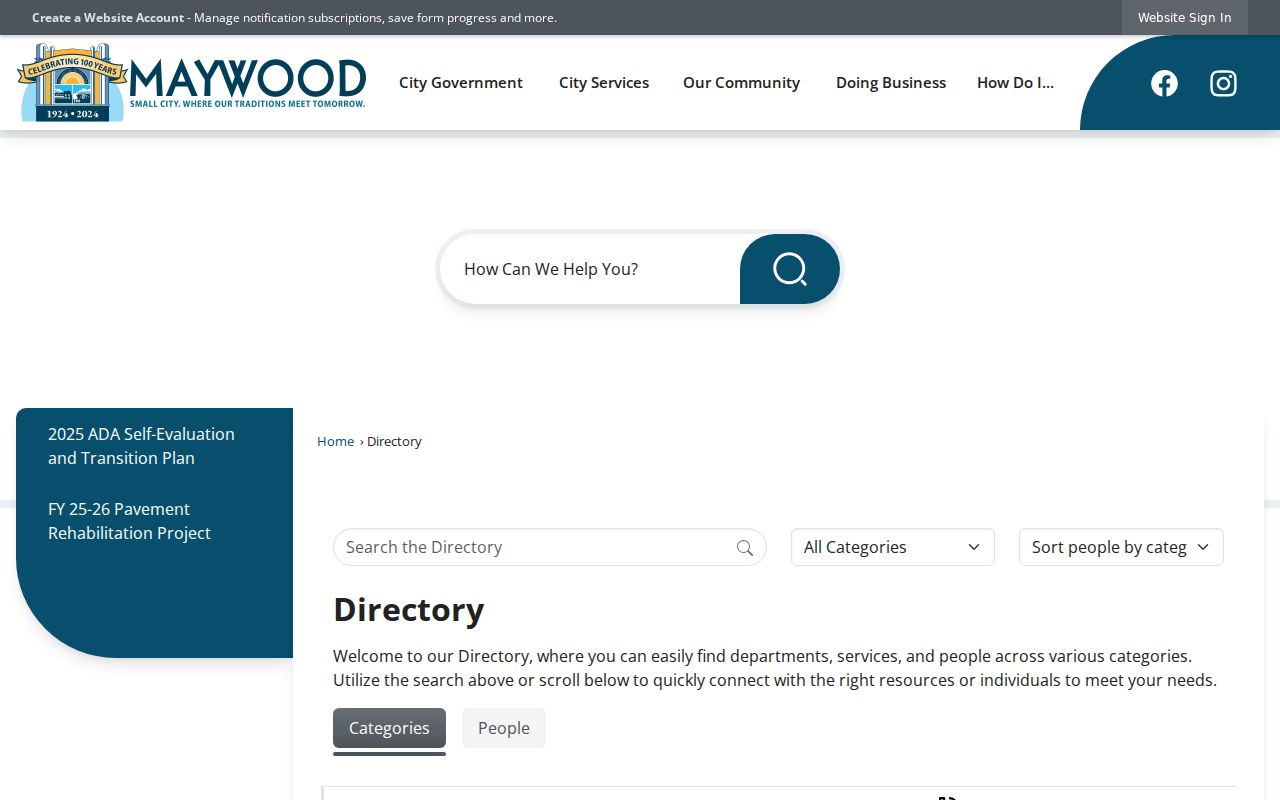
City contacts can route a request or local-history question, but they should not be mistaken for a household directory.
Maywood Directory Business Lists
Business and organization lists can add a name, address, or civic role to a historical Maywood search. The city Resource Directory points to schools, community groups, and service organizations. Business licenses and Secretary of State filings can connect an entity or officer to a place. These sources describe organizations and public contacts. They do not reveal private member rosters or turn a business location into a home address.
Use a business clue to cross-check a directory entry, not to replace it. Capture the entity name, filing date, agent, public address, and role. Then compare a city directory, newspaper, permit, or Recorder instrument. An old business can explain why an address appears in a reverse directory even when no household name is printed.
The Maywood business directory supplies organizational context for a city-directory search.
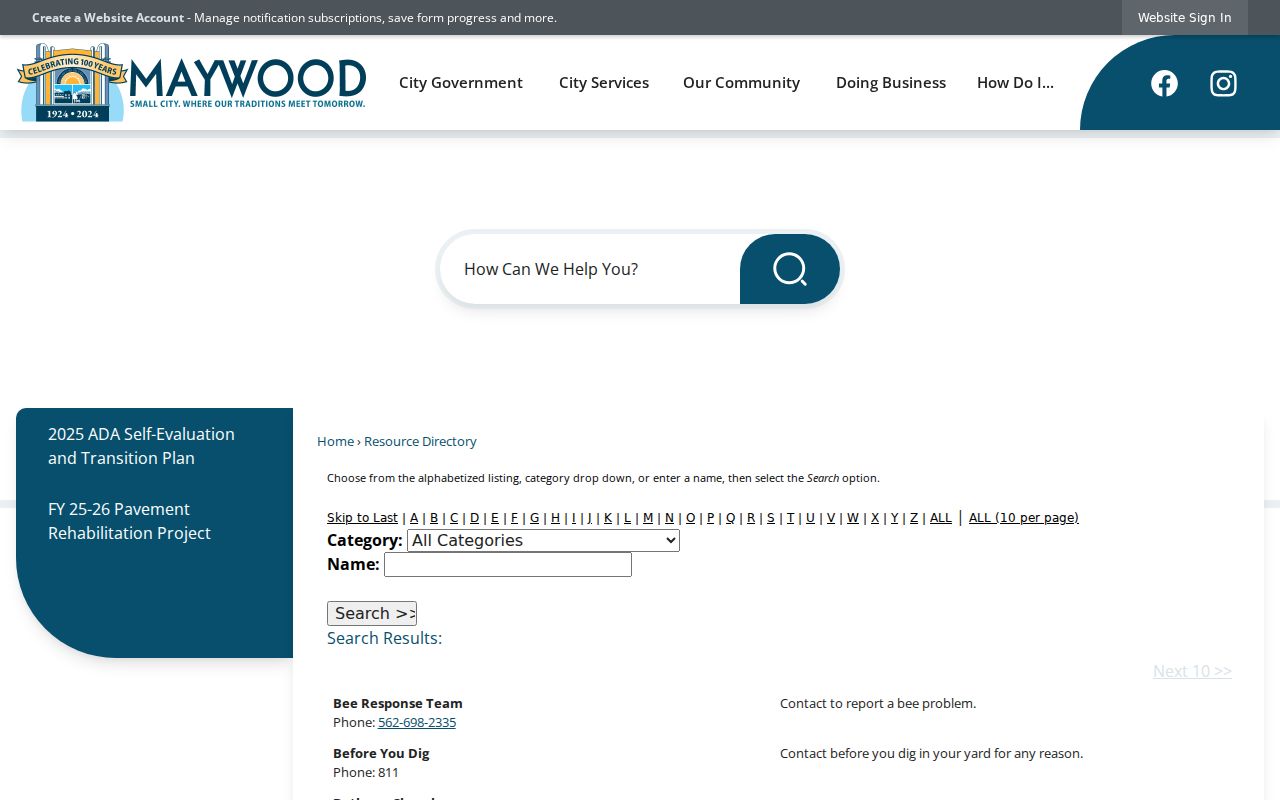
Organizational contacts add context while the historical volume remains the source for the listed entry.
Maywood Directory Timeline
A short chronology keeps a Maywood city directory search tied to real local history. Regional publishing began with Waite and Beane's 1872 Los Angeles City and County Directory. Maywood's library opened in 1921. The city incorporated in 1924 at about 1,000 people. The first three public post-incorporation census schedules came in 1930, 1940, and 1950. LAPL's digitized and reverse collections then extend the search into later twentieth-century volumes, but not every Maywood year is verified.
| Year or span | What it means for Maywood research |
|---|---|
| 1872 | Regional Los Angeles city-and-county directory publishing is documented. |
| 1921 | Maywood's library begins in Lincoln School. |
| 1924 | Maywood incorporation creates a useful boundary for later labels. |
| 1930-1950 | Three public post-incorporation census checkpoints. |
| 1875-1987 | LAPL digitized selection, with community coverage checked volume by volume. |
There is no verified first or last Maywood-only printed directory year in the research. Ask LAPL or the Californiana staff to confirm a proposed publisher and volume rather than inserting a familiar publisher name without evidence.
Maywood Directory Gaps and Geography
Historical records do not fail in one neat way. A Maywood entry can be absent because the volume omitted the community, the scan is not indexed, the street name changed, the household was not listed, or the person moved. Pre-1924 entries may use county or township geography. A numbered street may appear in several forms. Spanish compound surnames, accents, initials, spacing, and anglicized forms deserve separate searches.
When a city directory result ends, add the LAPL History of Your House workflow: legal description, deed sequence, directories, probate, maps, permits, newspapers, and census. Sanborn maps can show a building footprint, material, use, or outbuilding. They do not name residential owners. Naturalization records at NARA Riverside/Perris, newspapers at LAPL, and the Norwalk Californiana Collection provide additional in-person channels.
Note: A missing Maywood city directory entry is a question for the collection keeper, not proof that the address was empty.